Municipal water treatment facilities constantly struggle with the complex logistics of bulk chemical supply chains. Managing high-concentration chlorine deliveries creates significant operational hurdles, including fluctuating costs and stringent safety liabilities. Storing pressurized chlorine gas or large quantities of industrial-grade bleach exposes staff to severe hazards and complicates emergency response planning. These logistical burdens often detract from the primary mission of providing safe, reliable water to the community.
Shifting to on-site sodium hypochlorite generation offers a robust, commercially viable alternative. This approach transitions the operational model from external chemical procurement to reliable, on-demand localized production. Facilities gain greater control over their disinfection processes while minimizing handling risks. Evaluating this transition requires a clear understanding of the technical mechanism, the installation footprint, and the broader operational impacts required to ensure continuous, compliant disinfection.
Key Takeaways
- An on-site sodium hypochlorite generator uses brine electrolysis to produce a low-concentration (typically 0.8%) chlorine equivalent, eliminating the degradation and safety risks of storing bulk 12.5% commercial bleach.
- The primary inputs are simply food-grade salt, water, and electricity, stabilizing long-term operating expenses against volatile chemical markets.
- System selection requires careful evaluation of hydrogen venting safety protocols, electrolytic cell lifespan, and required daily chlorine demand for scalable municipal water disinfection.
- While capital expenditures (CapEx) are higher than bulk dosing systems, the return on investment (ROI) is typically realized through reduced transportation, handling, and hazardous material compliance costs.
Core Mechanism: The Brine Electrolysis Process
Understanding how a system generates chlorine begins with the fundamental chemistry involved. The process utilizes a straightforward reaction: mixing water and salt to create a brine solution, which then passes through an electrical current. This electrochemical reaction produces sodium hypochlorite, represented by the equation: NaCl + H₂O + Electrical Energy → NaOCl + H₂.
The production process involves several critical steps to ensure efficiency and safety.
Water Softening
First, facility operators must remove calcium and magnesium from the influent water. These minerals cause scaling on the electrodes inside the cell. Without softening, efficiency drops, and the internal components face premature wear.
Brine Saturation
The system mixes softened water with high-purity salt to create a saturated brine solution. The consistency of this brine remains essential for accurate reaction parameters. Precise concentration levels directly influence the quality of the final product.
The Electrochlorination System
The facility pumps the diluted brine through an electrolytic cell. This cell contains titanium electrodes coated with specialized mixed metal oxides. This process of brine electrolysis triggers the conversion of the brine solution into sodium hypochlorite.
Hydrogen Mitigation
Hydrogen gas acts as a necessary byproduct of the electrochemical reaction. Safety protocols dictate that the system must safely separate and vent this gas. Dedicated blowers push the byproduct to the outside atmosphere, ensuring it never accumulates within the room.
Storage and Dosing
The system stores the generated 0.8% sodium hypochlorite solution in a holding tank. From here, automated pumps deliver the solution into the water supply at precise rates. This closed-loop system ensures consistent disinfection without the need for manual handling of concentrated hazardous chemicals.
Equipment Architecture: Components of an Automatic Sodium Hypochlorite Generator
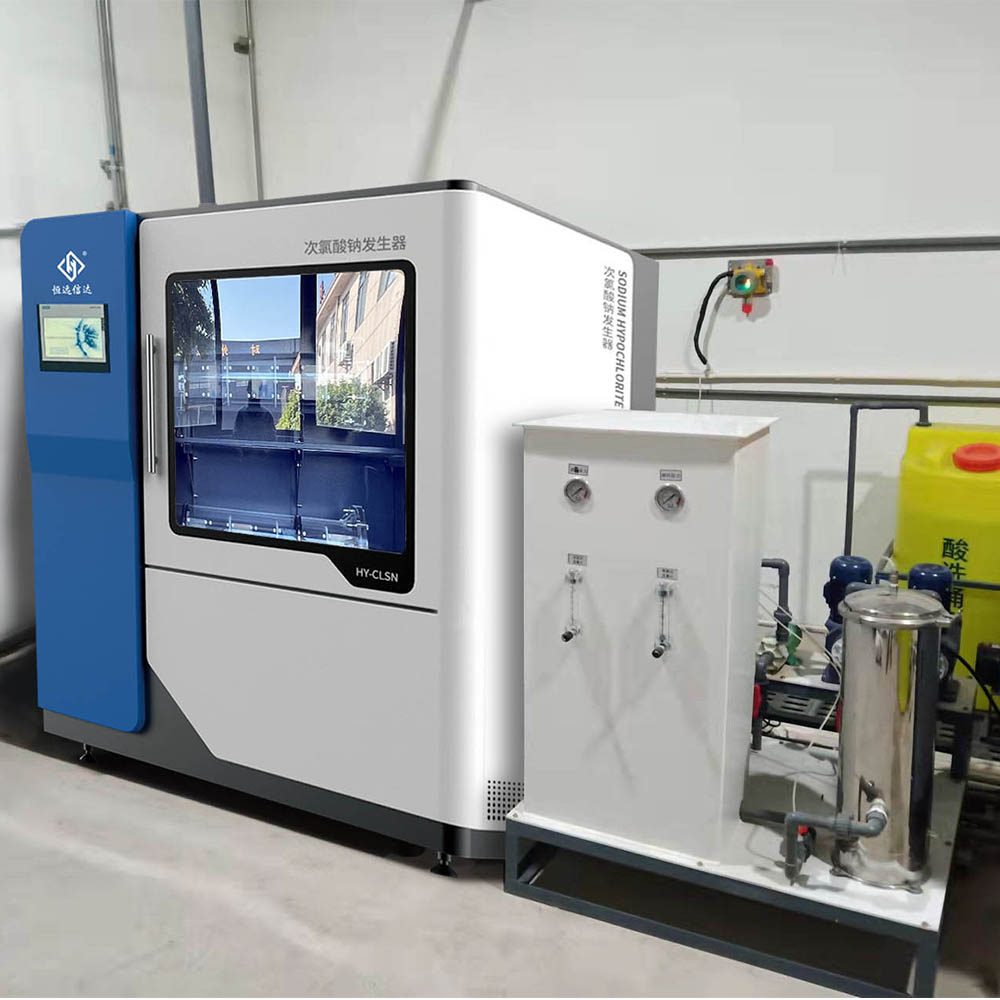
Success depends on the reliability of the hardware. An automatic sodium hypochlorite generator comprises several engineered subsystems designed to work in tandem. Modern designs prioritize modularity and ease of maintenance to minimize downtime.
Water treatment facilities should prioritize systems that incorporate robust components. The water softener and chiller systems are vital. They ensure that influent water remains within specific temperature and hardness ranges. If the water exceeds these specifications, the electrolytic cell suffers, which reduces its operational lifespan.
The brine tank and proportioning pumps regulate the feed. These components ensure the system maintains the exact brine-to-water ratio required for optimal electrical efficiency. Inaccurate ratios lead to wasted electricity or incomplete reactions, driving up costs unnecessarily.
The electrolyzer cell functions as the core engine of the system. Engineers evaluate two main designs: tubular and plate. Tubular cells often provide better flow characteristics, while plate designs can offer simpler maintenance access. Decision-makers must assess power consumption metrics, specifically the kilowatt-hours required per pound of free available chlorine produced.
Finally, the control panel serves as the brain of the operation. Modern systems integrate seamlessly with SCADA networks. This connectivity allows operators to monitor voltage, flow rates, and tank levels in real time. Advanced PLCs (Programmable Logic Controllers) provide fail-safe operations, automatically shutting down the system if parameters deviate from safe ranges.
On-Site Sodium Hypochlorite Generation vs. Bulk Chemical Alternatives
Comparing on-site systems to bulk delivery reveals stark differences in risk profiles. Bulk 12.5% commercial bleach poses significant handling challenges. It is a hazardous material that requires stringent storage protocols and poses risks during unloading.
Conversely, the 0.8% solution produced by an electrochlorination system falls well below the threshold for hazardous material classification. This lower concentration drastically reduces the regulatory burden and eliminates the extensive EPA Risk Management Plan (RMP) requirements associated with chlorine gas or high-strength bleach.
Chemical degradation also favors on-site generation. Bulk hypochlorite begins to lose strength the moment it leaves the manufacturer. Factors like heat and exposure to light accelerate this decay, leading to the formation of chlorate byproducts. On-site generation creates fresh solution continuously. This immediacy prevents degradation and eliminates the formation of unwanted byproducts during storage.
Supply chain resilience provides another major advantage. Facilities relying on bulk chemicals remain vulnerable to delivery interruptions caused by weather, road closures, or supplier shortages. On-site systems flip this dynamic. They rely on dry salt, a stable, inert material that facility managers can stockpile for months without degradation.
The following table outlines the key differences between these two common disinfection approaches:
Comparison of Disinfection Strategies | Feature | Bulk Bleach Delivery | On-Site Generation |
| Safety Classification | Hazardous (12.5% concentration) | Non-hazardous (0.8% concentration) |
| Product Stability | Degrades over time | Generated fresh on demand |
| Supply Dependence | Frequent truck deliveries | Dry salt storage (long-term) |
| Regulatory Burden | High (RMP and specialized storage) | Low (Standard chemical handling) |
Key Evaluation Criteria for Drinking Water Disinfection Equipment
Selecting the right drinking water disinfection equipment involves rigorous planning. Facilities must first accurately size the generator. You should match the generation capacity, measured in pounds of chlorine equivalent per day, to the plant’s peak flow. Ignore seasonal fluctuations at your own peril; ensuring the system can handle summer demand spikes is mandatory.
Regulatory compliance remains non-negotiable. Always verify that both the equipment and the resulting sodium hypochlorite solution meet NSF/ANSI 61 and NSF/ANSI 372 standards. These certifications confirm that the equipment does not leach harmful contaminants into the potable water supply.
Operations and maintenance require a transparent look at resource consumption. While this article avoids specific financial frameworks, operational efficiency remains a priority. Calculate the expected kilowatt-hour usage and salt consumption rates. Factor in the anticipated lifespan of the electrolytic cells, which typically ranges from five to eight years. These variables dictate the long-term sustainability of the installation.
Space constraints often define the project scope. Assess the available footprint within your current facility. You need adequate square footage for the generator skid, brine storage tanks, and necessary piping. Do not overlook the requirements for hydrogen venting. Ductwork must route to a safe outdoor location, which may necessitate specific architectural modifications to the existing room.
Implementation Realities: Maintenance, Risks, and Rollout
Transitioning to on-site production demands a proactive maintenance strategy. Electrode scaling represents the most common operational challenge. Minerals present in the source water inevitably build up on the electrodes over time. This buildup creates electrical resistance and reduces output efficiency. While some systems feature self-cleaning mechanisms, most require a routine acid-washing cycle to restore performance.
Salt quality directly impacts the health of the system. Using low-grade salt introduces impurities like bromide or heavy metals. These contaminants accelerate the erosion of the expensive MMO coatings on the electrodes. They can also contribute to the formation of regulated disinfection byproducts (DBPs). Procuring high-purity, food-grade salt ensures a longer equipment life and better water quality.
Safety around hydrogen gas remains paramount. Although hydrogen is a natural byproduct of electrolysis, its accumulation creates explosive risks. The generation room must include redundant ventilation systems and gas sensors linked to the control panel. This setup guarantees that if ventilation fails, the system automatically stops production.
Successful rollout also requires staff training. While the systems automate much of the work, operators must understand how to interpret SCADA data, manage salt inventory, and perform periodic inspections. Creating a preventive maintenance schedule during the commissioning phase sets the team up for long-term success.
Conclusion
Transitioning to an on-site system provides a strategic upgrade for facilities prioritizing safety, supply chain independence, and operational stability. It removes the hazards of bulk chemical management and provides a resilient alternative to unpredictable market forces.
Engineering and plant managers should begin by conducting a 12-month historical audit of their current chlorine consumption. Next, assess local utility rates for power and water to understand the operational profile. Map the available footprint within your facility to ensure the equipment fits comfortably, including all necessary venting requirements. Finally, approach vendors with these data points to request a detailed feasibility study tailored to your specific flow requirements.
FAQ
Q: What is the concentration of sodium hypochlorite produced on-site?
A: The system typically produces a 0.8% (8,000 ppm) solution. This concentration is classified as non-hazardous, which significantly reduces handling and safety risks for facility staff while remaining highly effective for drinking water disinfection.
Q: How long do the electrolytic cells last before needing replacement?
A: The lifespan of an electrolytic cell usually spans five to eight years. This duration depends heavily on factors like raw water hardness, the purity of the salt used, and strict adherence to recommended maintenance protocols, such as regular acid washing to remove mineral deposits.
Q: Does on-site generation eliminate the risk of disinfection byproducts (DBPs)?
A: No. While the process minimizes the formation of chlorate and perchlorate typically associated with degrading bulk bleach, the presence of standard DBPs—such as trihalomethanes (THMs) and haloacetic acids (HAAs)—depends primarily on the organic precursors naturally present in the source water.
Q: What is the average ROI period for an electrochlorination system?
A: The return on investment varies significantly based on local chemical supply costs and utility rates. However, most municipal facilities typically observe a break-even point occurring between three to seven years after initial installation.
Q: Can an on-site system handle sudden spikes in water treatment demand?
A: Yes, these systems can handle demand spikes effectively. The key lies in engineering the system with adequate storage tank capacity. This reserve allows the facility to draw from a pre-generated stockpile of solution during peak flow events, ensuring continuous disinfection without stressing the generation equipment.
 English
 العربية
 Français
 Русский
 Español
 Português
 Deutsch
 italiano
 日本語
 한국어
 Nederlands
 Tiếng Việt
 ไทย
 Türkçe
 አማርኛ
 ພາສາລາວ
 Bahasa Melayu
 Filipino
 Bahasa Indonesia
 magyar
 Română
 Монгол
 қазақ
 Српски
 हिन्दी
 فارسی
 Kiswahili
 Slovenščina
 Svenska
 Ελληνικά
 Suomi
 Dansk
 Shqip
 বাংলা
 Oʻzbekcha
 Azərbaycan dili
 íslenska


