Upgrading a large-scale water treatment facility requires precise oxidation and disinfection capabilities. Selecting the wrong equipment leads to severe operational bottlenecks. It also causes compliance failures. We must evaluate every component rigorously.
Modern industries are shifting heavily toward ozonation. This technology excels at complex contaminant removal. It reduces biochemical oxygen demand (BOD) and chemical oxygen demand (COD). It removes stubborn color and destroys resilient pathogens. Crucially, ozonation achieves these results without generating harmful chlorinated byproducts.
This article provides a transparent, engineering-focused framework. You will learn how to evaluate and select an Ozone Generator. We will align this selection with specific facility demands, regulatory standards, and long-term operational efficiency goals.
Key Takeaways
- Precise sizing relies on calculating accurate ozone demand, factoring in flow rates, contaminant loads, and target oxidation levels rather than generic facility square footage.
- Feed gas quality (Liquid Oxygen vs. PSA Oxygen) directly dictates ozone concentration and overall system efficiency.
- A complete ozone water treatment system must account for mass transfer efficiency (dissolving the gas into the water) and safe off-gas destruction, not just raw generation capacity.
- Vendor selection should be based on pilot-testing capabilities, transparent Total Cost of Ownership (TCO) modeling, and compliance with industrial safety standards.
Defining Success Criteria for Wastewater Ozonation
Establish Baseline Water Quality
You cannot size an ozone system accurately without baseline water data. Influent parameters dictate the entire design. We must analyze biochemical oxygen demand (BOD) and chemical oxygen demand (COD). Total organic carbon (TOC) and total suspended solids (TSS) also require careful measurement.
Facility operators must identify competing ozone scavengers. Nitrites present a major challenge. They consume ozone rapidly before it can attack target organics. High TSS levels shield pathogens from oxidation. You must filter out suspended solids upstream. Comprehensive water profiling ensures the wastewater ozonation process functions at peak efficiency.
Identify the Primary Objective
Every facility uses ozone differently. You must define the primary goal before selecting equipment. Common objectives include:
- Primary Disinfection: Using the system as robust water disinfection equipment to destroy bacteria and viruses.
- Targeted Oxidation: Breaking down complex molecules. This includes removing active pharmaceutical ingredients (APIs) or endocrine disruptors.
- Sludge Reduction: Treating activated sludge to reduce overall biomass volume.
Different objectives require vastly different contact times and dosing strategies. Disinfection happens quickly. Complex oxidation requires prolonged contact and higher residual levels.
Determine Ozone Demand and Dosage
Sizing relies on a formulaic approach. You must calculate the required dosage in milligrams per liter (mg/L). We base this on peak water flow rates and the specific contaminant oxidation pathways.
Engineers calculate total demand using this fundamental relationship: required dosage multiplied by the maximum flow rate. We then add a safety margin. This margin accounts for mass transfer inefficiencies and sudden spikes in contaminant loading. Precise calculations prevent undersizing the system. They also prevent massive energy waste from extreme oversizing.
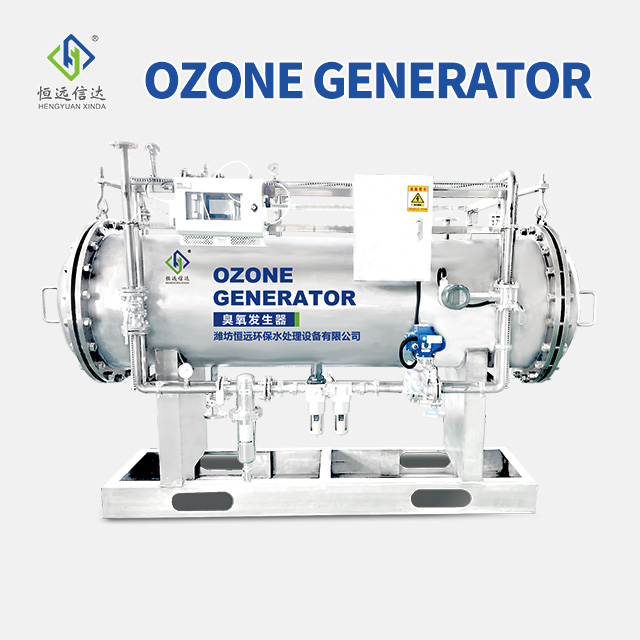
Core Technologies: Corona Discharge vs. Alternatives
The Industry Standard
The corona discharge ozone generator stands as the definitive choice for industrial applications. It passes an oxygen-rich feed gas across a high-voltage electric field. This splits diatomic oxygen molecules to form ozone.
This technology scales seamlessly. It delivers high concentration outputs essential for large water volumes. Corona discharge units operate with exceptional energy efficiency compared to older methods. They handle continuous, heavy-duty industrial cycles reliably. Most municipal and large industrial plants rely exclusively on this technology.
Dismissing Inadequate Tech
Ultraviolet (UV) ozone generators work well for small residential pools. They fail completely in high-capacity industrial water treatment. UV systems produce very low ozone outputs. They consume massive amounts of energy per gram of generated ozone.
Cold plasma generators also struggle to meet industrial demands. They often lack the robust scalability required for continuous high-flow wastewater applications. Relying on inadequate technology guarantees performance failures. Stick to corona discharge for industrial loads.
Cooling Mechanisms
Generating ozone produces intense heat. Heat destroys ozone rapidly. Therefore, cooling mechanisms dictate system efficiency. Continuous industrial operation requires closed-loop water cooling systems.
These cooling systems maintain the optimal temperature for the dielectric tubes. If the dielectric surfaces overheat, ozone production plummets. Proper cooling water flow prevents dielectric degradation. It maximizes equipment lifespan and stabilizes the ozone output curve over time.
Key Evaluation Dimensions for an Industrial Ozone Generator
Evaluating Output Capacity
Operators measure ozone output capacity in grams per hour (g/h) or kilograms per hour (kg/h). You must evaluate this capacity against your facility's peak and average demand. A properly sized industrial ozone generator handles worst-case flow scenarios effortlessly.
Turndown ratio is equally critical. Wastewater flows fluctuate daily. The generator must throttle its output down during low-flow periods. A high turndown ratio prevents energy waste. It also prevents dangerous overdosing when water demand drops unexpectedly.
The Importance of Concentration
Higher concentration improves everything. Industrial units typically target an 8-12% ozone concentration by weight. Dissolving gas into liquid follows Henry's Law. A higher gas-phase concentration drives more ozone into the water matrix.
High concentration reduces the required volume of feed gas. It shrinks the physical footprint of downstream contactors and piping. It also enhances mass transfer efficiency significantly. Do not compromise on concentration levels when evaluating system specifications.
Feed Gas Preparation Systems
The quality of your feed gas determines the reliability of your generator. Industrial facilities generally choose between two oxygen sources. They use either onsite Pressure Swing Adsorption (PSA) generators or Liquid Oxygen (LOX) bulk tanks.
Table 1: Feed Gas Technology Comparison
| Feature | PSA Oxygen Systems | Liquid Oxygen (LOX) |
| Supply Method | Generated onsite from ambient air | Delivered in bulk cryogenic tanks |
| Oxygen Purity | 90% - 95% | 99% - 99.9% |
| Logistics | No delivery trucks required | Requires regular truck deliveries |
| Dew Point Control | Requires strict desiccant drying | Inherently ultra-dry |
| Best Application | Remote sites, steady daily demand | High-capacity, fluctuating large demands |
Moisture is the enemy of corona discharge. Feed gas must maintain a dew point below -60°C. If moisture enters the reaction chamber, it combines with nitrogen to form nitric acid. Nitric acid corrodes dielectric tubes rapidly. It causes catastrophic equipment failure. Strict dew point monitoring is absolutely non-negotiable.
Implementation Realities: Mass Transfer and Safety Integration
Dissolving the Ozone
Generating the gas is only half the battle. You must dissolve it efficiently into the water matrix. Poor mass transfer wastes the ozone you just generated. Facilities typically choose between two main dissolution technologies.
- Venturi Injectors: These use a pressure differential to create a vacuum. They suck the ozone gas into the water stream, shearing it into micro-bubbles. Venturi systems achieve over 90% mass transfer efficiency. They require booster pumps but offer superior dissolution.
- Fine Bubble Diffusers: These sit at the bottom of deep contact basins. They release ozone bubbles that rise through the water column. They rely on buoyancy and extended contact time. Diffusers are simpler but generally less efficient than Venturi setups.
Off-Gas Destruction
No system dissolves 100% of the ozone. Unreacted ozone collects at the top of the contact tanks. You cannot vent this off-gas directly into the atmosphere. It poses severe respiratory hazards and violates environmental regulations.
Facilities must install thermal-catalytic off-gas destructors. These units heat the collected off-gas and pass it over a catalytic bed (often manganese dioxide). The catalyst breaks the ozone down safely into standard diatomic oxygen before venting. Sizing the destructor correctly ensures absolute safety.
Safety and Monitoring
Ozone is a toxic gas at high ambient concentrations. Comprehensive safety integration protects your workforce. Every modern ozone water treatment system requires overlapping safety protocols.
You must install ambient ozone sensors around the generator and contact basins. These sensors trigger alarms and shut down production if they detect leaks. Furthermore, inline dissolved ozone monitors and ORP (Oxidation-Reduction Potential) controllers track treatment efficacy. Tie all these sensors directly into the facility’s SCADA system for real-time oversight and automated response.
System Reliability and Shortlisting Logic
Maintenance and Reliability
Industrial water treatment runs continuously. Equipment downtime leads to untreated discharge. Therefore, system reliability must dictate your shortlisting process. Evaluate the lifespan of the dielectric tubes. High-quality dielectrics should withstand years of continuous operation if the feed gas remains ultra-dry.
Look for power supply redundancy. If a single power module fails, the entire generator should not go offline. Modular power supplies allow the system to operate at reduced capacity while repairs happen. Additionally, verify the local availability of replacement parts. Waiting weeks for specialized components shipped from overseas paralyzes facility operations.
Vendor Vetting and Pilot Testing
Never procure full-scale equipment based solely on theoretical calculations. Water chemistry contains unpredictable variables. Competing scavengers often alter the required dosage in real-world conditions.
Demand a proof of concept. Shortlist vendors who provide robust pilot testing capabilities. Start with bench-scale laboratory tests using your specific wastewater samples. Follow this with an on-site slipstream pilot test. Running a small-scale unit on a continuous slipstream of your actual influent validates the required dosage. It proves mass transfer efficiency and confirms expected oxidation results. Only commit to large-scale procurement after successful pilot validation.
Conclusion
- Choosing the correct industrial generator requires aligning your specific water chemistry data with raw generation capacity.
- Feed gas quality directly influences both mass transfer efficiency and long-term equipment survival.
- Never prioritize short-term equipment savings over robust system integration, automated monitoring, and operator safety mechanisms.
- Compile your facility's baseline water quality data today. Use it to request an engineering consultation or a dedicated pilot study from a qualified systems integrator.
FAQ
Q: How do I determine the right ozone output capacity for my plant?
A: You determine output capacity by multiplying your peak water flow rate by the required ozone dosage. You derive this dosage from specific lab testing of your contaminant load. Always add a 15-20% safety margin to account for mass transfer losses and unexpected flow surges.
Q: What is the expected lifespan of a commercial corona discharge ozone generator?
A: High-quality commercial units typically last 10 to 20 years. However, this lifespan is entirely contingent on strict maintenance. You must maintain ultra-dry feed gas to prevent nitric acid formation. You must also ensure continuous, proper cooling water flow to prevent dielectric degradation.
Q: Do I need an oxygen concentrator, or can I use ambient air?
A: Small commercial setups sometimes use ambient air. Heavy industrial systems strictly require concentrated oxygen (from PSA or LOX). Concentrated oxygen achieves the necessary 8-12% concentration threshold. It also strips out nitrogen, which prevents the formation of corrosive nitric acid inside the generator.
Q: Is wastewater ozonation safe for facility operators?
A: Yes, it is highly safe when engineered correctly. The system must operate under negative pressure. It must include automated leak detection, ambient air monitors, and SCADA integration. Finally, you must install properly sized off-gas destruction units to ensure compliance with OSHA and EPA exposure limits.
 English
 العربية
 Français
 Русский
 Español
 Português
 Deutsch
 italiano
 日本語
 한국어
 Nederlands
 Tiếng Việt
 ไทย
 Türkçe
 አማርኛ
 ພາສາລາວ
 Bahasa Melayu
 Filipino
 Bahasa Indonesia
 magyar
 Română
 Монгол
 қазақ
 Српски
 हिन्दी
 فارسی
 Kiswahili
 Slovenščina
 Svenska
 Ελληνικά
 Suomi
 Dansk
 Shqip
 বাংলা
 Oʻzbekcha
 Azərbaycan dili
 íslenska


